
Remember 2023? Labour was in opposition, preparing for government. Amost any charity campaign that landed on a Labour MP’s desk got a warm reception.
Fast forward to 2026 and the welcome has cooled. Labour MPs haven’t stopped liking charities; it’s that, like every party in power, they’ve found that governing is harder than opposing.
We know this because our nfpPolitics Westminster tracker asks a representative panel of around 100 MPs every quarter which charity campaigns they support. Over the last four years, that’s let us track nearly 200 campaigns in Parliament. So here’s what happened when Labour moved from the opposition benches into government.
Labour MPs and charity support: from cheerleaders to cautious
Before the 2024 election, Labour MPs supported, on average, 66% of the charity campaigns we tested. Since the election, that has fallen to 51%.
Conservative support went slightly the other way, from 35% to 40%. What was a gap of more than 30 points between the parties has shrunk to around 10.
Chart 1: The gap between Labour and Conservative support for charity campaigns has narrowed sharply since the election
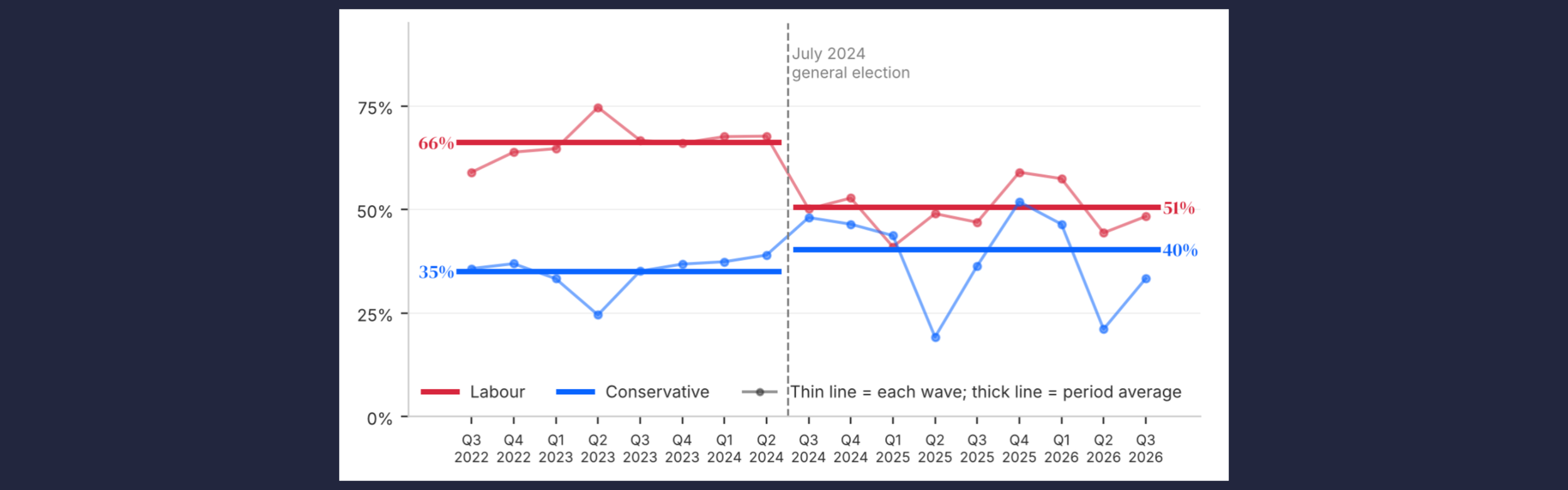
Average % of MPs supporting each charity campaign tested, by party. Source: nfpResearch, nfpPolitics Westminster MP survey. Base: 196 charity campaigns, 17 waves, Summer 2022 to Summer 2026.
The view from the government benches
None of this is a falling out. Just after the election, 94% of Labour MPs said the charity sector is a force for good. What changed is their job. In opposition, backing a charity campaign costs very little and can put pressure on the government. In government, every campaign is either a claim on a stretched budget or a challenge to a decision your own ministers have made.
The clearest sign is in campaigns that take on the government directly. In opposition, Labour MPs supported 72% of charity campaigns challenging the Conservative government’s policy. Under Keir Starmer, they supported 25% of those challenging their own, on issues such as the Winter Fuel Payment, employer National Insurance and welfare reform. One newly elected Labour MP summed it up: “They have to [campaign on] this, obviously. I can’t support it, obviously.”
Conservatives moved the other way, from 24% in government to 56% in opposition. Only ten campaigns in total took on the government, so the exact figures need care, but the direction is clear.
The new intake plays a part too. More than half of today’s MPs were first elected in 2024, and new Labour MPs have been more likely than returning colleagues to hold the government line.
So, what should charities do?
Accept that no government can please everyone all of the time, and campaign accordingly. Labour MPs tell us they respond to charities that acknowledge progress, recognise that trade-offs are hard, and keep the relationship intact while still pushing for more.
Welfare reform is the obvious test. As one Labour MP said of a charity they rate: “They [charities] have decent politics and they know Labour MPs want to help - they don’t beat us over the head cos we haven’t helped yet - welfare reform is hard.”
A lot of this happened under Keir Starmer. Andy Burnham has been Prime Minister since July, but his MPs face the same budget and the same trade-offs. Whether a new leader changes how they respond to charity campaigns is the next thing our tracker will tell us.
Fancy a closer look?
If you’d like to know where your charity stands with MPs, or how your next campaign will land under a new Prime Minister, get in touch at insights@nfpresearch.com or call 020 7426 8888.
The findings in this blog come from our forthcoming nfpPolitics special report, a four-year look at how MPs from each party see charities. Look out for it in the coming weeks.